
Risk assessment template for Australian workplaces
A risk assessment that scores each hazard from 2 to 10 before and after its controls, with the same matrix and definitions AREESA uses, a named person responsible and the sign-off. Word and PDF, emailed to you.
Word and PDF. Emailed to you, no sales call.
What it is for
A risk assessment is the working behind a safety decision: what could hurt someone, how badly, what you are doing about it, and how much risk is left once you have. Done properly it is a short document that anyone on the job can read and act on, not a spreadsheet nobody opens.
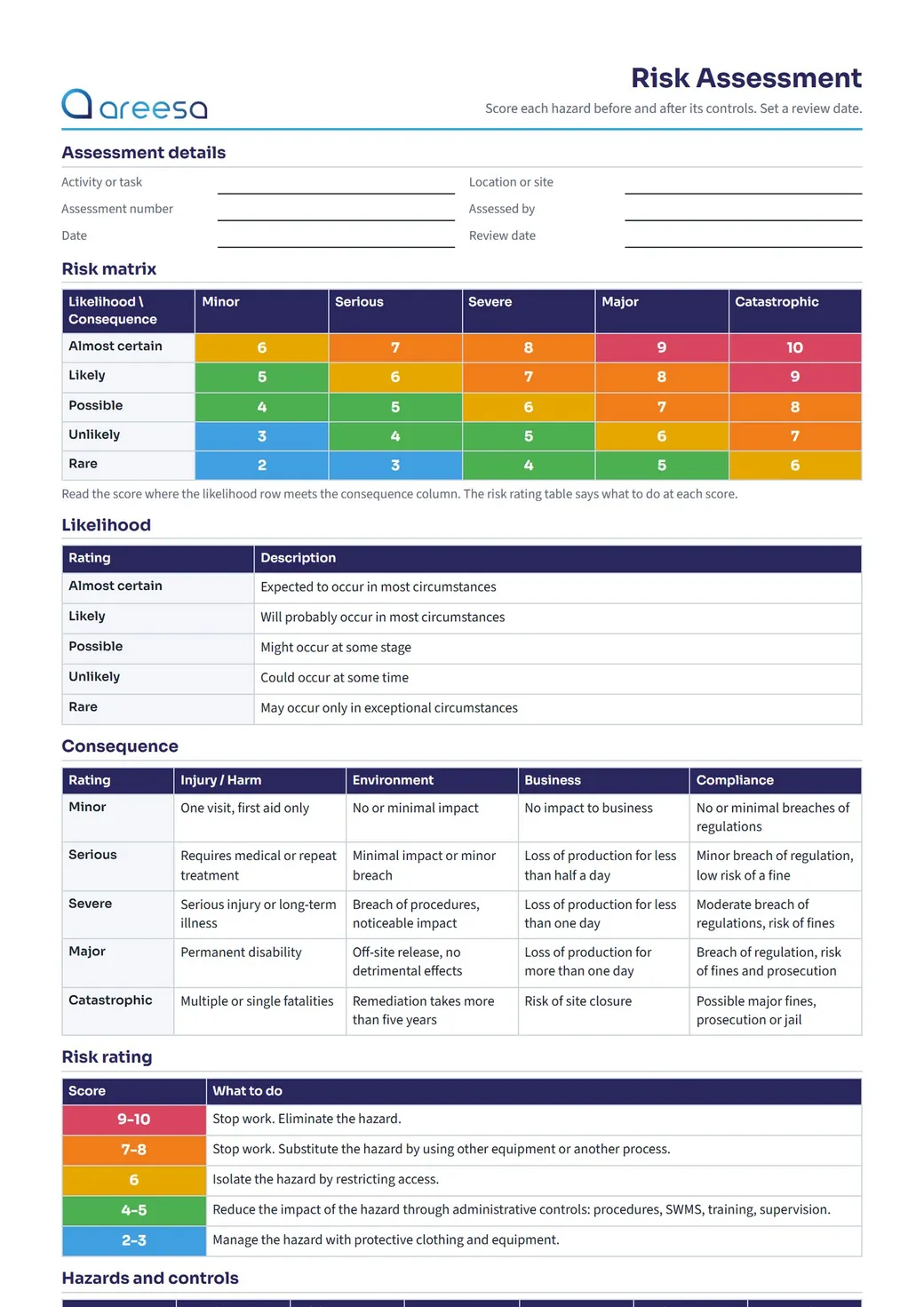
This template uses the matrix AREESA runs on. Likelihood and consequence each have five levels, the score where they meet runs from 2 to 10, and a risk rating table says what to do at each score, from protective equipment at the bottom to stopping work and eliminating the hazard at the top. The likelihood and consequence tables define every level, with consequence read across injury, environment, business and compliance, so two people rating the same hazard land on the same score.
What is in the template
- Assessment details: activity, location, assessor, date, review date and assessment number.
- The 2 to 10 risk matrix, colour-coded by band.
- A likelihood table defining Almost certain, Likely, Possible, Unlikely and Rare.
- A consequence table defining Minor to Catastrophic across injury or harm, environment, business and compliance.
- A risk rating table: what to do at each score, tied to the hierarchy of controls.
- A hazards table: hazard, who is at risk, initial score, control measures, control type, residual score and responsible person, with space for eight hazards.
- Sign-off for the assessor, a reviewer and an approver, with dates.
How to use it well
- Score the hazard on its own first. The initial score with no controls is what tells you how much the controls matter.
- Read the definitions before you score. Likely means it will probably occur; it does not mean you can picture it happening.
- Take the consequence from the worst column that applies. A hazard with a minor injury but a site closure is still a Major.
- Set the review date when you write it. An assessment without one quietly becomes out of date.
Further reading
- Model Code of Practice: How to manage work health and safety risks, Safe Work Australia
- Codes of Practice, SafeWork SA
Before you use it
This template is a general starting point only. It is not advice, it was not prepared for your workplace, and it does not take account of your sites, your work or the requirements that apply to you. You are responsible for checking it, adapting it and deciding whether it is suitable before you use it. AREESA accepts no responsibility or liability for any loss, injury or damage arising from its use.
When the paper version stops scaling
In AREESA a risk assessment is a record, not a document. Hazards sit by category with initial and residual scores from this same matrix, every control is tagged by type, every version is kept, the review date flags itself when it passes, and the people who need to read it acknowledge it by name.
Questions
What is the difference between a risk assessment and a SWMS?
A risk assessment scores hazards and records the controls for an activity, area or piece of plant. A SWMS is a step-by-step method for a specific high-risk construction task and is signed by the crew doing it. Most sites use both: the assessment feeds the SWMS.
How do I use the risk matrix?
Use the likelihood and consequence tables to pick the row and the column for the hazard as it stands, then read the score where they meet. Do it once before the controls and once after. The second score should be lower, and if it is not, the controls need work. The risk rating table tells you what each score calls for.
Can I change the matrix or the definitions?
Yes. The Word version is fully editable. If your organisation already has its own matrix and wording, paste it in so the template matches the rest of your system.
How often should a risk assessment be reviewed?
Whenever the work, the plant, the people or the site changes, after any incident, and otherwise on the review date you set at the top. Twelve months is a common default.
See the risk assessment template running in AREESA.
A 30-minute demo with your documents and your sites, not a canned tour.