“We bought twelve gas detectors. We can find seven.”
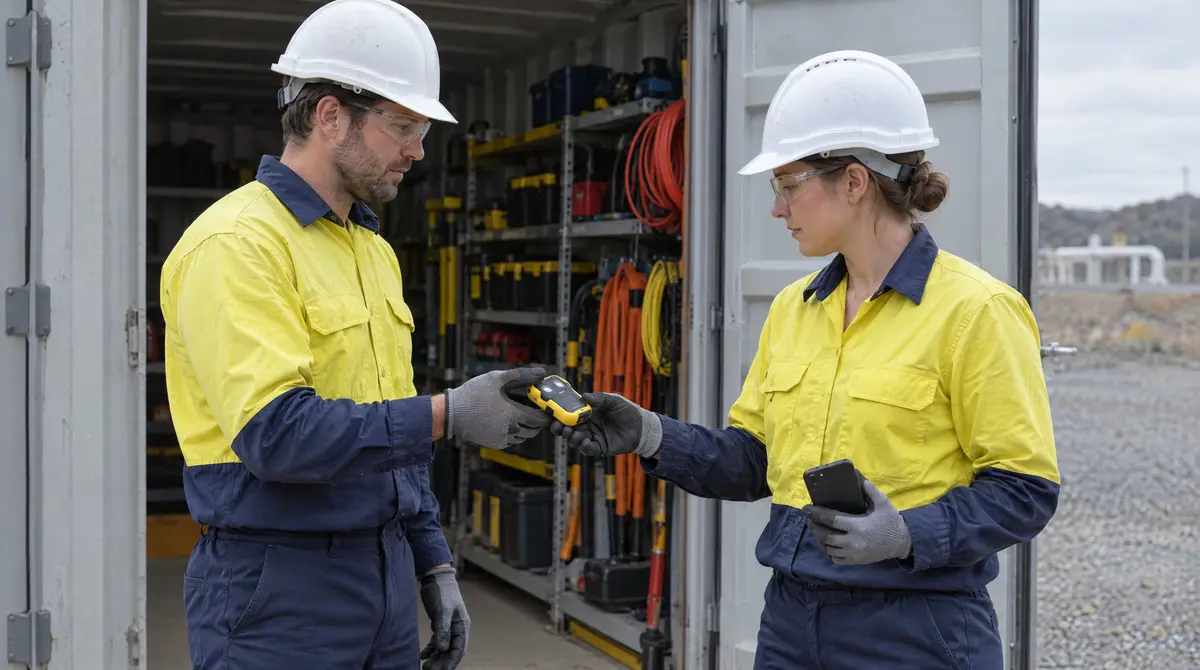
Every business that issues equipment to people has a version of this. Radios, harnesses, gas detectors, laptops, keys, power tools, fuel cards, vehicles. They go out with a person and come back, or do not, and nobody can say who had them last. The fix is simple to describe: every asset is assigned to a named person, reassigning it takes one button, and the asset’s record shows who held it and when. When an asset always has an owner, it stops going missing.
Why assets go missing
Assets rarely get stolen. They drift.
- Handovers aren’t recorded. A tool passes from one worker to another on site and the register still shows the first name, if there is a register.
- The register lives in one place, the assets in another. A spreadsheet in the office cannot see what is in the back of a ute.
- Nobody has to give it back. When someone moves role, site or leaves the business, there is no list of what they are holding.
- Damage has no owner. An asset comes back broken and nobody knows when it happened or who had it.
What it costs
Replacement cost is the obvious one. The less obvious costs are larger.
Safety equipment that can’t be traced is a safety gap. If a business cannot say who holds each harness or gas detector, it cannot be sure each one has been inspected, is in date, and is with someone trained to use it. That is much harder for an item nobody can find.
Time disappears. Supervisors ring around. Jobs wait for equipment that is “somewhere”. Duplicate purchases cover for items sitting unused in someone’s vehicle.
Exits leak assets. Without a record of what a departing worker holds, items leave with them.
A spreadsheet versus an assigned asset
| Question | Asset spreadsheet | Asset accountability in AREESA |
|---|---|---|
| Who holds it | Whoever was written down at purchase | A named person, changed with one button |
| Handover | Verbal | Recorded: who had it, who has it, when it changed |
| Condition | Unknown until it breaks | Pre-starts, inspections and damage reports on the asset |
| Out of service | A note, if anyone wrote one | Tagged out on the record, visible to everyone who opens it |
| When someone leaves | Nobody knows what they had | Their assets found by current holder and reassigned |
| History | Purchase date, maybe a service date | Every holder, form, service and damage report against the asset |
How AREESA does it
Every asset is a record. Each item has its own profile: what it is, its identifier, its documents, its forms, its service history and its full custody history. The equipment maintenance software page shows the record.
Every asset has a person. Assets are assigned to the worker holding them. When an asset moves, someone reassigns it, and AREESA keeps the history: assigned to whom and when, removed by whom and when, newest first.
Checks follow the asset. Pre-starts, inspections and services are completed against the asset, so custody and condition are read on the same screen. A failed answer can report damage or request a service, and a faulty item can be tagged out with one button.
A handover check is optional. Some businesses want a condition form with photos at every handover. That form can be attached to the asset and filled in on the phone. Nothing in AREESA forces it before a reassignment, and we would rather say so than imply a control that is not there.
Find it by scanning. Assets carry a QR code, so the holder, history and checks are a scan away.
A pattern from multi-site implementations
A pattern the AREESA team sees across implementations, not a named client.
A business issuing tools, radios and safety equipment to crews across several sites tracked them in a spreadsheet updated at purchase and rarely after. Items moved between crews without a record, supervisors spent time each week finding equipment, and departing workers’ equipment was recovered when someone remembered.
With AREESA, each asset was set up with its own record and assigned to a named person. Reassignments happen on the phone as equipment changes hands, inspections and damage reports sit on the asset, and when someone leaves, their assets are found by holder and reassigned before they go.
Why AREESA
A spreadsheet that lists an asset is a list. An asset with a current holder, a recorded chain of who held it, and its inspection history attached is a record you can act on. Configured around the equipment you issue, implemented by the AREESA team, hosted in Australia and built for assets spread across many sites.