“We’ll write it up properly when we’re back at the office.”
That is how most incident reports start, and it is where most of them lose their value. By the time someone is back at a desk, the photos are on three different phones, the witness has gone home, and the details have softened into a summary. The fix is recording the incident at the scene, as it happens, on the phone already in the worker’s pocket, so the first record is also the best one.
Why the first hour matters
An incident record has to answer what happened, where, to whom, who saw it, what the scene looked like, and what was done straight away. Every hour between the event and the record makes those answers less reliable.
- Memory fades and blends. Witnesses compare notes and their accounts converge.
- The scene changes. Equipment gets moved, spills get cleaned up, barriers come down.
- Photos scatter. They are taken, but on personal phones, with no clear link to the incident.
- Near misses disappear. If reporting is a hassle, a near miss gets mentioned in passing and never logged.
Most incidents are minor. They still need recording well, because the register is how a business sees what keeps happening and shows what it did about it.
Written up later versus recorded at the scene
| What matters | Written up later | Recorded at the scene in AREESA |
|---|---|---|
| Timing | Hours or days after | At the time, timestamped |
| Who reported | A name on a form | The signed-in user who logged it |
| Photos | On personal phones, maybe attached later | Taken as part of the report |
| Location and asset | Described in words | Linked to the site and the asset involved |
| Where it goes | An email thread | One incident register, visible to the people who manage it |
| Near misses | Rarely logged | Quick enough that they get reported |
How incident recording works in AREESA
- Start from wherever the worker is. Open an incident report on the phone, or open the asset involved and start the report from there so the vehicle, plant or equipment is already linked.
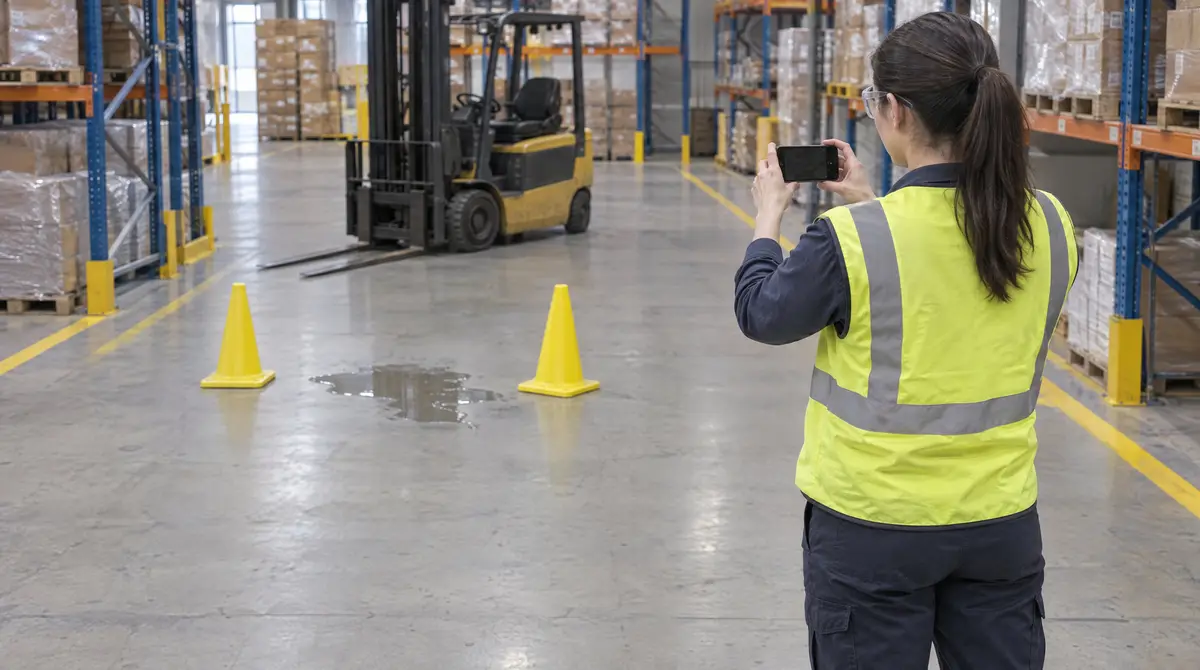
- Capture it while it is fresh. What happened, who was involved, witnesses, photos taken within the form. The report is timestamped and attributed on submission.
- It lands in the register. Every incident, near miss and hazard sits in the one incident register, filtered by site, by asset or by date, rather than in whoever’s inbox received the email.
- The asset remembers. An incident started from an asset shows on that asset’s record beside its pre-starts and services, so a machine with a history has a visible one.
A pattern from multi-site implementations
A pattern the AREESA team sees across implementations, not a named client.
A business with crews spread across several sites ran incident reporting on a paper form that supervisors were meant to scan and email in. In practice reports arrived days later, photos came separately or not at all, and near misses were almost never recorded.
With AREESA, workers record incidents and near misses on their phones at the scene, starting from the asset involved where there is one. The safety lead opens one register instead of an inbox, and sees the photos with the report. Near-miss reporting went from rare to routine because it takes about as long as describing what happened.
Why AREESA
An incident written up the next day is a summary. An incident recorded at the scene, attributed, timestamped, linked to the site and the asset, and sitting in one register with everything else that has happened there, is a record. AREESA gives you that record; what you do with it stays with you. Configured around your sites, implemented by the AREESA team, hosted in Australia.