
Incident report form template for Australian workplaces
A two-page incident report that captures the facts while they are fresh: the incident, the people, the injury and treatment, what happened, what was done, why it happened, and what will stop it happening again. Word and PDF, emailed to you.
Word and PDF. Emailed to you, no sales call.
What it is for
An incident report records what happened, to whom, and what the business did about it. It is written in the hours after an injury, a near miss or damage to plant, when memories are sharp and the site is as it was. Written well, it is the start of the investigation and the end of the argument about the facts.
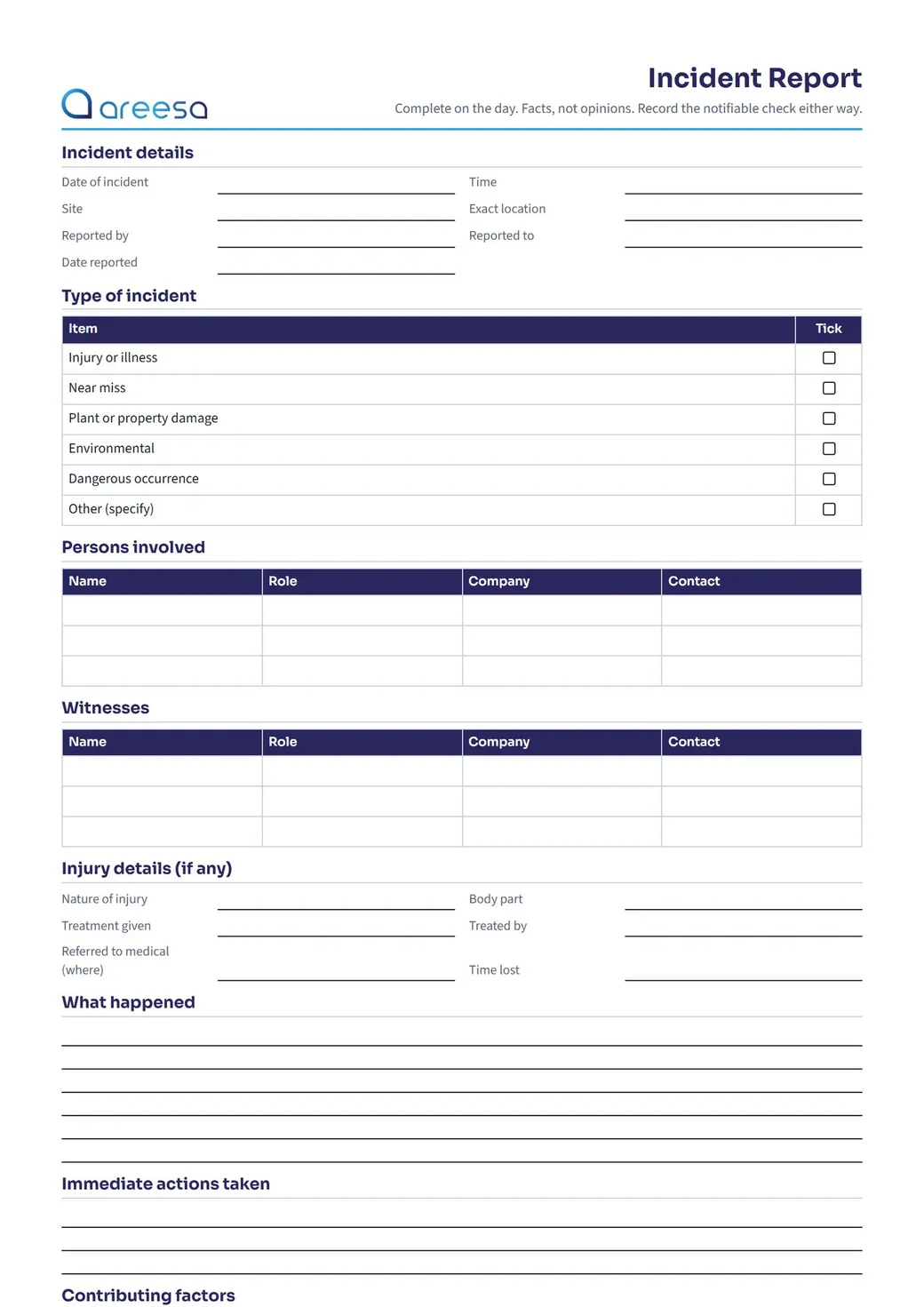
This template walks through the report in the order the questions get asked. Where and when, what kind of incident, who was involved and who saw it, the injury and its treatment, a plain description, the immediate actions, the contributing factors, and the corrective actions with owners and dates. There is a line to record the notifiable-incident check and the sign-off.
What is in the template
- Incident details: date, time, site, exact location, reported by, reported to and date reported.
- Incident type: injury, near miss, plant or property damage, environmental, dangerous occurrence, other.
- Persons involved and witnesses with role, company and contact.
- Injury details: nature, body part, treatment, treated by, referred to medical, time lost.
- What happened, immediate actions, contributing factors, and corrective actions with an owner and a due date.
- A notifiable-incident check and sign-off by the reporter, supervisor and manager.
How to use it well
- Facts first, opinions never. Write what was seen and done, not what someone thinks should have happened.
- Get the witnesses' details on the day. A week later they are on another site.
- Work out whether the incident is notifiable to your state regulator and record the decision either way, with the time.
Further reading
- Incident notification, Safe Work Australia
- Notify SafeWork SA, SafeWork SA
Before you use it
This template is a general starting point only. It is not advice, it was not prepared for your workplace, and it does not take account of your sites, your work or the requirements that apply to you. You are responsible for checking it, adapting it and deciding whether it is suitable before you use it. AREESA accepts no responsibility or liability for any loss, injury or damage arising from its use.
When the paper version stops scaling
In AREESA the incident form is one tap from the dashboard on any phone. Every report emails the person you nominate the moment it is submitted, the incident register holds every report with its type and location, and notifiable incidents and days lost show in your metrics without a spreadsheet.
Questions
When should an incident report be written?
As soon as the injured person is looked after and the site is safe, on the same day. The form is designed to be filled in quickly by the supervisor with the people involved.
Does a near miss need a report?
Yes. A near miss is the incident that did not hurt anyone this time. Reporting it is how you stop the next one. Tick Near miss under incident type and fill in the rest.
What is a notifiable incident?
Each state's WHS regulator defines the serious incidents that must be reported to it, such as a death, a serious injury or a dangerous incident. The form has a line to record that you checked, what you decided and when. Check your state regulator's list rather than guessing.
Who signs the report?
The person who reported it, the supervisor who investigated, and a manager who accepts the corrective actions. Three signatures, three dates.
See the incident report form running in AREESA.
A 30-minute demo with your documents and your sites, not a canned tour.